Last Friday was the first time in ten years that air-raid sirens sounded in the Gush.
For my family and I, having just made aliyah, it was the first time ever.
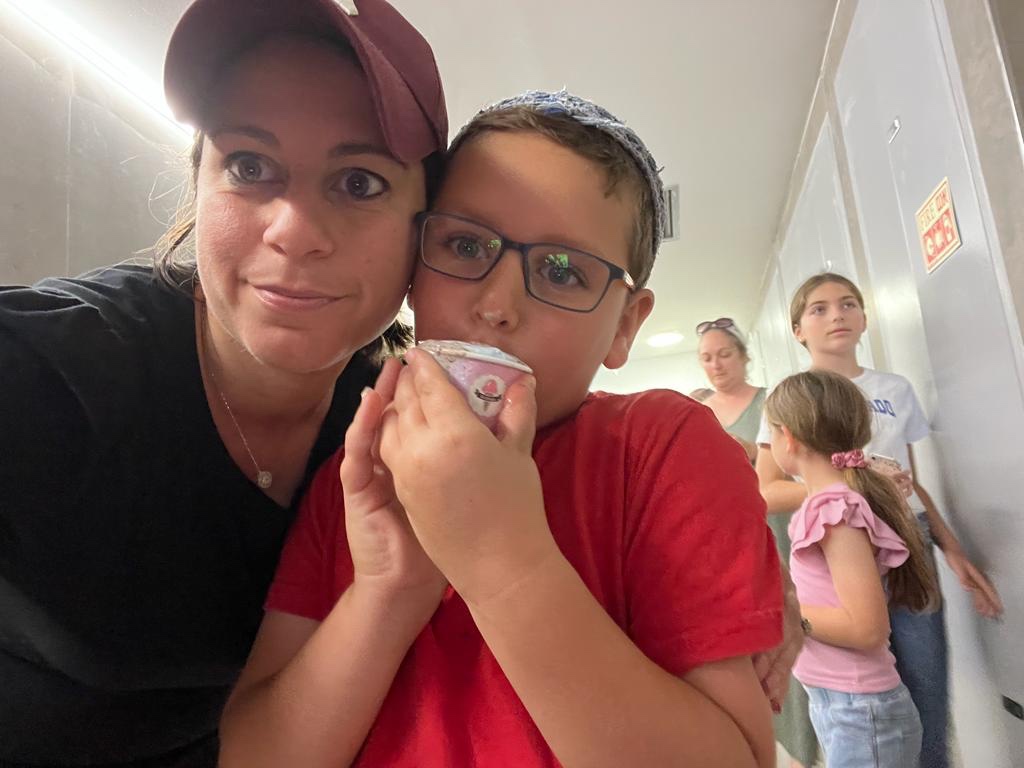
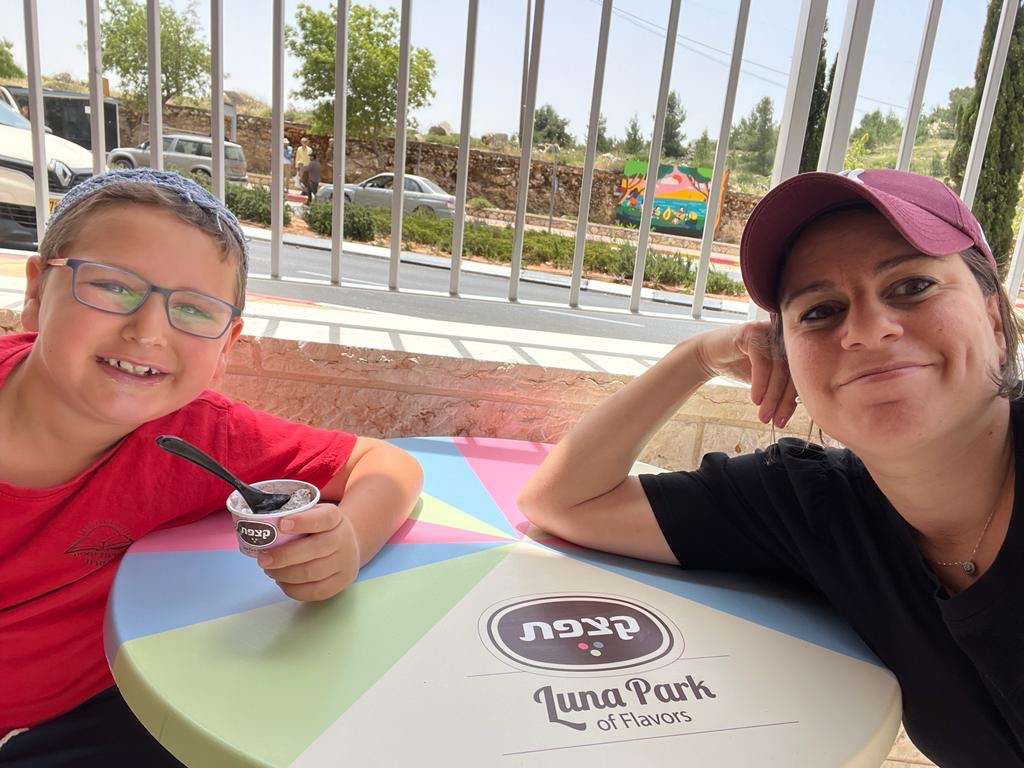
We live in the Zayit neighborhood of Efrat and the previous day we had decided that we would take our 7-year-old, Eytan, out for some special Abba and Ima time together after school. We left his older three siblings at home, and with our youngest, Eyal, still at gan, we made our way down to the new Efrat Center, which is located just below where we live, and headed into the store “Katzefet” to get some ice cream.
Naturally, Eytan wanted to try all of the flavors. The staff was very patient with him; my wife Nataly explained that he must make a decision and choose a flavor. He chose and received a tall cup filled with two colorful flavors of ice cream topped with whipped cream and sprinkles – a real treat. The smile that came over his face was priceless and both my wife and I smiled at each other for this little Friday afternoon delight.
I handed Nataly a twenty shekel bill so she could pay when suddenly, over the hustle and bustle of the ice cream store, I hear the sirens. I called to her, “Sirens! Nat – there are sirens,” and I called publicly, “We have to move indoors!” She couldn’t hear me right away, nor could the others, but as I tried to repeat myself, people began to realize what was happening, and once they did the rush began.
“Azakah!” screamed a man rushing out of the ice cream store. “Azakah!” (Azakah means “warning” or “alert.”)
Panicked families who were out with their kids or who were doing some Friday afternoon shopping before Shabbat rushed to find and collect their children and make their way indoors to the nearest secured area. Nataly grabbed Eytan’s hand and told him to follow her. “Ima, I need a spoon!” Trying not to panic him, she said, “Don’t worry, we’ll get one soon.” He swiftly demonstrates to us that he can lick it just as well without a spoon, and, seeing her nervous, and thinking back to his recent Tekes Yom HaZikaron, he said, “Ima, it’s an Azakah. It’s okay.”
With the rest of the crowds, we moved to the more secure location within the recesses of the strip mall and cram into the stairwell where the elevators are located. Neighbors are working to calm children they don’t even know, asking them questions like what their names are; are they scared; would they like to use their cell phone to call their parents? Nataly asks Eytan if he’s okay and he replies, “Yeah, I’m okay. And I really like the ice cream!” As we too try to keep those around us calm, Nataly turns towards me in a panic and says: “The kids! They’re at home! What about Eyal at gan?!”
“Don’t worry,” I replied. “They’re going to be fine. The women at the gan know exactly what to do. And I went over with the oldest just a few days ago what to do in the event they hear the sirens.”
She tries to call them; she can’t get through.
“We need to check! Please! Please go and check!”
“I will. Just hold on for a minute. It’s going to be fine.”
I took stock of the situation and the families and people around me. Parents holding their children, complete strangers and shop workers all huddled together, waiting out the attack. We heard the distant explosion a few seconds later and felt the impact.
Either the Iron Dome had done its job, or the rocket fell in a nearby field.
Not being able to reach our kids via phone was a good sign in my mind, as that meant they were most likely in our miklat, bomb shelter, where once the door is closed, there is virtually no cell reception.
When I saw that Eytan was okay and enjoying his ice cream and that she was okay, I signaled to Nataly that I’ll head back to the house to check on the kids.
Even though the sirens were still sounding, I knew a way to navigate through the underground parking lots of the Efrat Center and arrive directly at our building while remaining undercover and safe.
After ten minutes, the all clear went out and I found my children at home, panicked, but safe. I calmed them down and complimented them on how well they handled themselves in the situation and praised their resiliency. Nataly and Eytan arrived soon after and taking one of my oldest along with me I went to pick up Eyal at the gan.
When they heard the siren, the morot had immediately ushered all of the children into the miklat which is where they had strategically set up the “Gymboree” – a padded obstacle play center which they use daily. During the attack, the morot kept the children safe and entertained by singing songs, playing games, and dancing with them. We returned home safely and as the excitement died down, we worked to get ready for Shabbat.
Last Friday was the first time I had been under rocket-fire as a civilian. As a soldier stationed in Gaza, I had experienced it several times. But as a civilian, with a family, I can tell you, without a doubt, it is an entirely different experience.
Yet huddled in that stairwell within the recesses of the mall, I never felt such an intense closeness and bond with those around me as I did on Friday. Never before had I felt such a firm resolve – not even as a soldier – for the need of our armed forces to eliminate the enemy threat from Gaza once and for all.
It was at that moment, huddled together with other families, that I discovered a profound truth: These Palestinian terrorists are so terribly misinformed. If they think firing rockets and missiles into civilian locales and putting families in harm’s way will somehow physically or psychologically weaken our nation or our resolve, they are sorely mistaken. It will only make us stronger, and more united than they can possibly imagine.
There it is, the dreaded North American Aliyah word: the Apostille!
Never will you face down a greater threat and hold-up to a person’s or family’s Aliyah than that sure-to-drive-terror-into-your-heart Apostille!
When I went to get our marriage license certified (which is a fancy way of saying notarized) in New York City at the county clerk’s office (which is something I had to do before getting it apostilled), I realized I had not only seen the word “Apostille” years before when I had to venture to the clerk’s office on different business, but that finally, twenty years later, I actually understood what the sign meant…
“NO APOSTILLES!” the sign reads. (Literally, with an exclamation mark.)
When I had seen this sign the first time when I was probably in my early twenties I had absolutely no idea how to even pronounce the word apostille, let alone know what it meant or why it had to be proclaimed so loudly and clearly at the front entrance to the clerk’s building. I think I remember thinking that Apostilles must be the official term for “vagrant” and the building was saying: “Back! Back with you, oh abhorrent Apostilles! Ye shall not loiter near this building, so help us God!” So in my mind apostille referred to either some kind of vagabond or someone who was trying to collect charity.
Twenty years later and that same sign is still there, plastered across the front entrance (in more than one location now in fact) and I finally understood what it meant and why the county clerk’s office would put a sign like that on its building. (Though I still can’t imagine anyone who hasn’t needed an apostille having the slightest clue as to its meaning…)
So what is an “Apostille”? And why are they so troublesome to obtain? (And why would the clerk’s building want you know that you can’t get them there?)
I must say that as we journeyed towards Aliyah we had been warned so many times over the years about getting these apostilles that I felt scared and quite a bit intimidated by the notion of having to obtain one. (One? Ha! Who are we kidding? We required no less than SEVEN. And from at least three different states! God help us…)
The truth is, apostilles are really not that big a mystery.
The easiest way to think of it is as a state’s official testament that a notarized or certified document that you possess is in fact legit. Put simply, an apostille is nothing more than a given state’s State Department attesting to the fact that your official document – which has been notarized or attested to or verified etc. – is in fact the document issued by the agency whose signatory is recognized by the state.
(Basically, it’s a fancy notarization saying that the signature on your document is legit. It is essentially the notarization FOR the notarization. That’s it.)
For example: What does our New York Marriage License apostille say on it? It says, “the person who signed off on this marriage license [Herby Hancock] is, in fact, the licensed and recognized person who is allowed to sign off on and recognize said license. Have a nice day.” To this they add a nice picturesque seal of the great state of New York – whatever the NY State Department seal happens to look like – and they either staple or fix that document to the document you needed apostilled. (You MUST keep the apostille attached to the document (do not remove it!) or it will void the entire thing.)
So how do you get an apostille and why is it so damn hard?
It’s actually not that hard when you know what you’re doing, but it is quite time consuming. Which is why there are services out there prepared to charge you as much as $250-$350 dollars to go and get them for you, quickly. Because by the time you have secured the correct documents that you need apostilled and gotten them to the right place, you may be looking at a wait time from 8-10 business days to as much as 3-4 weeks to get them back apostilled. That’s the reality. This is the timeline piece of the Aliyah process that it would be very helpful to understand and appreciate, but unfortunately, [and I’m speaking from my own experience here] when you make Aliyah, it seems that the last thing anyone wants to give you is a sense of what your actual Aliyah timeline will look like. (But that is for another blog post.)
Typically, the only government agency that can issue apostilles is the State Department of that state. For example, in the state of New York (and also in New York City), apostilles are given and processed where the State Department offices are, which are almost uniformly located in the state’s capitol, which in this case would be Albany. There are exceptions to this rule, for example, if someone needs documents apostilled immediately some agencies have the authority to “apostille” them without having to go through the state department. New York City’s Department of State (yes, New York City has its own Department of State…), for example, will, provided you make an appointment ahead of time and can show that you are leaving the country within the next two weeks, issue you same-day apostilles in their NYC office without having to ship your docs to Albany. New Jersey also offers “apostilles while you wait” services in their Trenton offices, but it will run you between $500 and $1000 per apostille depending on how long you want to wait ($500 for a 2-hour wait, $1000 for a 1-hour wait – I kid you not.) But generally speaking, if you need something apostilled, you’ll have to either travel to your state’s capitol, OR have your documents shipped there to the correct offices.
Every state issues a different form of apostille – which makes sense, because each state knows (or is supposed to know, or be able to verify) the government official who signed their official document and should be able to attest to that. So if you have documents that originate in Pennsylvania for example (say, a birth certificate) then you are going to need to get that document apostilled in Pennsylvania’s State Department, which is located in Harrisburg, the capitol of Pennsylvania. In this case, if you live – like I do – in Philadelphia, making the hour-and-a-half drive to Harrisburg to the capitol building is not such a big deal. (Especially since they take walk-ins, something that is not offered in every state. And especially since in Harrisburg, they will literally apostille your document in seconds, while you wait, and it costs just a few dollars.) If you live in Erie however, you’re crap out-of-luck and you will either have to mail your documents to Harrisburg to get apostilled -OR- make the whopping ten-hour drive round-trip to Harrisburg for what is basically a two-minute process. (And trust me, Pennsylvania is amazing in this regard.)
Before COVID, many, if not most, State Departments allowed walk-ins, and getting apostilles on your documents was either a matter of taking a trip to your state’s capitol and running around for a bit to find the right office and wait on line to get it done, or – for those who didn’t want to make the trip – just mailing it in and getting it back within a week or two. COVID however shut down most state department buildings or severely hampered or limited their interactions with the public, thus making the process a veritable nightmare and often taking two to three times the amount of time needed to get this done.
However, since several of the more important documents a family needs for Aliyah (such as birth certificates and marriage licenses etc.) require apostilles, this becomes one of the more lengthy and drawn-out processes of the entire Aliyah journey. If you and your spouse (and your children, which is how it was with our family) were born in different states then you will each need to not only obtain your original birth certificate from those states, but then get those certificates apostilled by the State Department of that particular state. (And for all intents and purposes, New York City – which I’ll get to – functions like its own independent state)
FOR EXAMPLE: I was born in New Jersey, our three oldest children were born in the Bronx (New York City), our fourth was born in Binghamton (New York State), and our fifth was born in Lower Merion (Pennsylvania). This required us to obtain apostilles from New Jersey, New York, New York CITY, and Pennsylvania. So, by comparison, if you are one of the lucky few who had that picture-perfect wedding on a beach somewhere in Hawaii, and your marriage was registered in Hawaii, you’re going to need to get your marriage license apostilled from the State Department in Honolulu.
What’s it going to cost and how long is it going to take?
The cost and timeline for obtaining an apostille varies from state to state. In Pennsylvania, once I got into the office, without an appointment, it cost me just a few dollars ($10 I think?) to get my son’s birth certificate apostilled and took literally less than two minutes. (The service was so fast that they actually requested I wait within fifteen feet of the check-in desk (and not leave the room!) so that I can take it and leave as soon as it was ready) In New Jersey, using expedited service ($45 fee) and dropping it off at the window in the Trenton office, it took nearly three weeks to get my birth certificate back by mail (which cost an extra $26 for an overnight USPS priority mail return envelope, which I chose to use, and which you need to supply them with to get your document(s) back). Of course, as mentioned above, New Jersey offers apostilles while you wait, and you can have them returned to you within an hour (or two) if you’re willing to pay $500 or even $1000. New York apostilles cost $10 per document to be apostilled, plus the cost of the envelope to Albany, and the cost of a return envelope to your home, and took close to three weeks to get back. (And this doesn’t include the amount of time you will need to wait in line to obtain your certificates, get them authenticated at a clerk’s office, or driving or traveling to the specific city to do this.)
Depending on the number of documents you need apostilled, when all is said and done you may spend as much as $1000 on dealing with these documents or as little as a few hundred or less, depending on what your needs are.
What else should you know?
When requesting apostilles by mail from your state’s State Department, you will, in almost all instances, need to supply your own mailing envelopes. You’d think that the apostille services would have envelopes on hand to sell you. This is typically not the case (but read the instructions online at your state’s Department of State for exceptions). Most locations will only accept first class, certified or registered mail envelopes, so it is important that you come prepared. These envelopes can often cost as much as the apostille itself, for example. we only used overnight USPS priority mail envelopes, for both sending the requests AND for the return envelopes. Each cost approximately $13, so in addition to the cost of the apostilles, we had to pay $26 in postage for each mail-in request for apostilles. Luckily we only needed to do this twice. And the reason for this is that if you are filing for multiple apostilles from the same state you can almost always send them in one envelope, and likewise only include one return envelope and you will receive them all together.
So in our case for example, we needed four apostilled certificates from NYC: Our Marriage License (1), and our three oldest children’s birth certificates (3). We only needed one sending envelope, and one return envelope to accomplish this as we sent them all together. The NYC Department of State – where you will have to go to get your documents apostilled – did not supply or sell envelopes, so since I was not prepared for this, I had to walk to the nearest downtown post office and purchase my priority mail envelopes first and then bring them over to the state department. Luckily I had enough time to do this before they closed. Navigating NYC’s bureaucracy is almost as bad as Israel’s, and sometimes it’s actually worse. I will be writing a separate blog-post about how to navigate some of the issues around the NYC apostille scavenger hunt.
Why I’m writing this
No one was around to really explain all of this to us. No one could really explain what apostilles were and how we were to obtain them. We had to figure it out on our own. We got some advice here and there, but an actual step-by-step explanation of what we needed to do we felt was nowhere to be found. My hope is that what I have written here will help others understand what they need to do and how to do it, and I’m hoping that this post will not only demystify the process a bit, but also help empower others to accomplish this step on their Aliyah journey and help them shed their fear or concern about what apostilles are and how to obtain them, and to realize that though the process may be a little complicated, it is doable. You CAN do this!
It was nearly 19 years ago today. May 2, 2004. The day before my birthday.
It was a usual day on the base, with the same tiresome guard shifts taking place, the same meal time schedule. The same tasks, and the same monotony. We were deployed in Gaza along the Kissufim road, and while we from time-to-time saw some intense moments, things today were relatively calm.
And then the call came in.
Two Palestinian terrorists. Armed. Rushing to the road. They have opened fire on a passing vehicle. We need support. Now.
My friends in the post called it in. From the base, we were alerted and then put on alert. I rushed to the radio room and command center where we could hear what was coming in, as well as see from the cameras around the area. It was horrific.
The terrorists – although depraved animals is more apt a description – who were spiked up on cocaine, meth, and God-only-knows what else in order to help them in their depravity and make them physically and psychologically impervious to pain and fear in order to carry out their task that much more successfully – hit the driver of the vehicle, causing it to slow and veer off the road. With speed and what can only be described as glee, they pounced upon the vehicle, surrounding it, with one animal on one side and other opposite his accomplice, and while circling the vehicle in a 360 degree motion, fired repeatedly into the windows, riddling the occupants with untold and uncounted number of bullets, murdering everyone in the automobile. The victims? Four young girls, Merav, Roni, Hadar, and Hila, ages 2, 7, 9, and 11. And their mother, Tali, the driver, age 34, who was in her 8th month of pregnancy.
The barbaric and horrific murder of the Hatuel family is an event that has been seared into the mind and psyche of not only myself and my cohort of friends who were on duty that day, but to tens of thousands who lived and bore witness to one of the most disgusting murders we had ever seen. To this day I have friends who have not lived down the incident and carry it with them constantly. Each of us feeling personally responsible for the attack and the ultimate pain it unleashed into the world.
In the immediate aftermath of the attack, I was called up from the base with three others from my unit to relieve my four friends who were on post during the incident. When we entered to relieve them and oversaw the change of the watch, the appointed soldier in charge of the post, my friend Micho’el, reviewed the events with us and explained what they had done to try and prevent the attack. I was to learn that my friends were not sleeping at the job. Not at all. That they had seen the barbarians immediately when they sprang from a nearby Palestinian home built close to the road, a house which we had *repeatedly* requested be demolished for it posed a distinct threat to the Israeli commuters with its conspicuously close proximity (less than 100 meters) to the road. Our requests were routinely denied by the high court of Israel on account of “humanitarian” reasons.
Within the mere 13 seconds that transpired from the moment the animals made their dash to the road and carried out their attack, Michoel immediately called it in over the radio. Without hesitating, my other friend Chai immediately managed to empty the entirety of his M-16 magazine clip – all 29 rounds (not fired on automatic) – and jump up onto the roof of the post and seize the FN-MAG heavy machine gun (which was not mounted) and begin firing it in earnest at them at a distance of nearly 600 meters. Despite the MAG not being secured to the guard rails above our post (it was never used), nor featuring the bipods or feet that would help stabilize it from the ground (they had been removed), my friend managed to get within just a few meters of the feet of the terrorists, but alas could not reach them in time.
As someone who was trained extensively on the MAG (I was the heavy machine-gunner in our platoon), I related to my friends who were cycling back to the base that to have accomplished this feat at that distance, under pressure, and with virtually no hands-on experience firing this weapon, let alone firing it under pressure, and without it being secured to a fixed position, as well as the bipods having been completely removed from this MAG it was downright miraculous, if not impossible, for him to fire as accurately as he did.
My words were of little comfort to my friends who returned to base feeling dejected and traumatized for having been eye-witnesses to the brutal carnage they had just witnessed just short while earlier and which, despite their efforts, they could not prevent. Two of our friends who were in the jeep patrol who arrived seconds after the attack were too late to prevent it, but not too late to neutralize the terrorists. Only later did I learn that my friend Yaniv, who was the mefaked (sergeant) in the jeep at the time of the attack and who took out the terrorists, lives to this day with regret and remorse and holds himself to blame for not having been able to arrive sooner and perhaps saved Tali and her daughters’ lives.
Taking over the post and relieving my friends after the incident was a sobering experience. I remember taking second watch, and during my initial downtime trying to adjust and get my bearings in the new position and environment. I was on my bed trying desperately to get some rest before my upcoming watch would begin. As I lay my head back against the inside padding of my vest, which I was using as a makeshift pillow, my cellphone rang. I sat up and observed the number – it was from overseas. Despite my not wanting to really talk to anyone, I answered the phone. “Hello?”
“Hey! Happy Birthday! Well, early birthday, kiddo.”
It was my older brother calling from the States to wish me an early happy birthday.
“I figured I’d be the first and beat the others to the punch. Am I first?” he lovingly and playfully inquired.
“You sure are.” I answered.
“How are things? You doing ok?”
“We’re a little stretched at the moment. We just had a major incident and I’m still trying to recover from it so I’m a bit out of it so I’m sorry if I don’t sound too excited on the phone. I’m glad you called. I’m just a little tired right now.”
“Hey, don’t worry about it. Listen, Happy Birthday. Be safe over there. Love you.”
“Thanks. Love you too. Thanks for the call.”
I remember that phone call like it was yesterday, just as I remember the incident like it was yesterday, talking with my friends in the tower as we relieved them from their post to cycle back to the base. I had no idea that I, let alone my friends, would be carrying the weight and the burden of this attack on our consciences and on our shoulders for years and years to come. Indeed not one of us as it turns out does not often think about that day and what transpired.
Aftermath
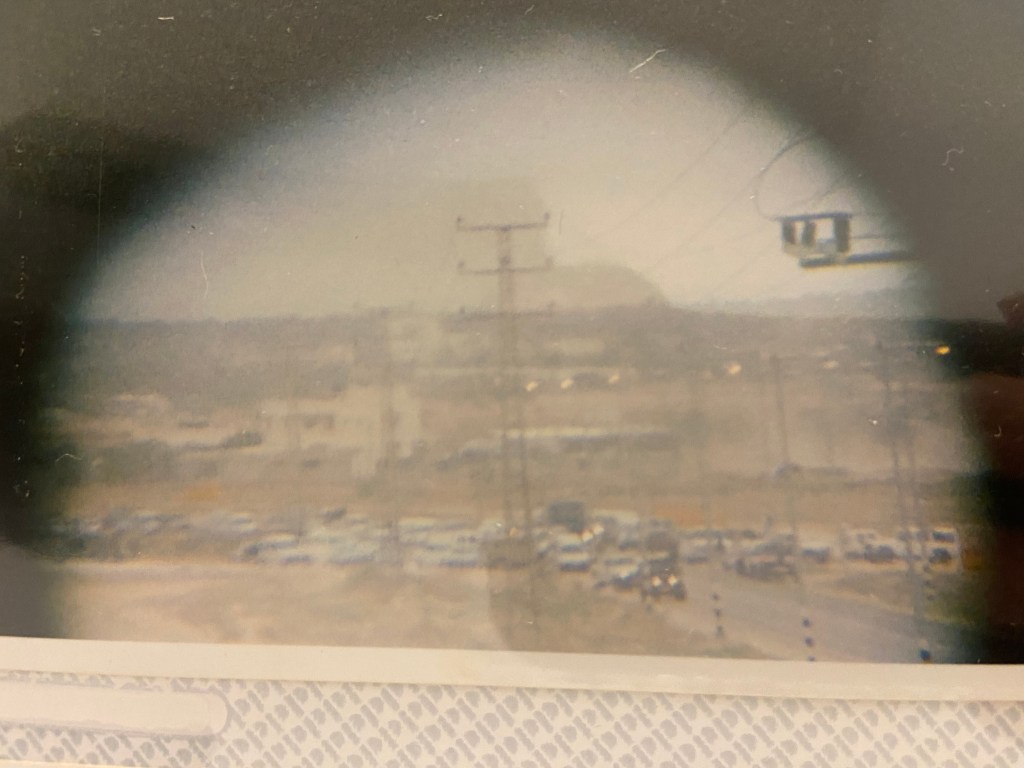
Exactly one week later while still at my post, the Shiva had concluded. Our Company Commander had arranged the security to enable a roadside memorial service to be held at the site of the attack. As one of the nearest posts, we were all on notice and we watched as family and friends of the Hatuels as well as other residents of the nearby settlements began to arrive and line up their cars to be present for the ceremony. I remember the radio chatter during the event, the sounds of high ranking officers coordinating the placement of vehicles and security and the higher-ups over the radio publicly praising my Company Commander for the way in which he arranged the event and the security. From my post I pulled out my disposable camera (I always had at least one handy to snap photos) and carefully aimed it through one of the pairs of binoculars to record a picture of the ceremony.
Moments after having snapped three photos, we heard the unmistakable sound of a Kalachnikov rifle being fired. We couldn’t believe that we were possibly about to witness and take part in another terrorist attack at the very same site!
Without hesitation the soldiers in my post immediately spring into action taking up defensive positions as I scrambled onto the roof to man the heavy machine gun. We could hear the direction of the fire coming from the very same house the terrorists had used just last week to carry out the previous attack! I radioed our CO letting him know our position and that we were ready to engage if they needed our support. I still will never forget the images I saw and what I was watching. Israelis running for cover behind their vehicles as our troops began to secure positions, advance towards the terrorists, and return fire.
Immediately, as if coordinated in advance, about half a dozen Palestinians started to leave the house from where the firing was taking place. They were dragging suitcases with them, almost all of them women. We couldn’t believe it, but it seemed that they knew that after this incident their home was going to be demolished and it seems that they were clearly ready for it.
About 30 minutes after the initial opening of fire upon our residents, the area was completely secure. We could hear the orders coming through over the radio to direct the D9 bulldozers to take down the house. The work would take all evening but it would ultimately be completed. The house that posed the threat was finally neutralized.
We later learned that the Palestinians who opened fire on the memorial service were themselves disguised as Arab women in order to blend into the crowd of those evacuating the house. At least one of the terrorists was killed as we returned fire. The second is believed to have been killed in the second stage of the advance. Despite my having a clear view of the house from which the terrorists were stationed, behind the house was a shallow valley and to avoid possibly firing over our own forces, we held our response from our position in check. I recall staying perched behind the MAG, guns at the ready, for over an hour while my friends below kept a careful ear to the radio in case we were asked to engage.
The memorial service ended thank God with no casualties or injuries other than the terrorists themselves. But we were nevertheless left stricken by how close we came to yet another ambush.
I think back to the attack that ended the lives of the four Hatuel daughters and their mother Tali quite often. Not just because of the horror, but because in some respects, it’s not possible to celebrate my birthday without first thinking about it. As it turns out, exactly five years later, on the 11th of Iyar, the exact Hebrew date of the attack, my son Ezra would be born, thus sharing a birthday with the Hatuel family’s yahrzeit. This connection never occurred to me until this year, when I did something I never thought I’d be able to do, and that was make contact with David Hatuel, Tali Hatuel’s husband, and finally speak to him face to face.
For years in the aftermath of the attack, I had never sought to engage with or even research what happened to David. I knew that he had gotten remarried a year later, as the news of his marriage was headlined around Israel at the time. I also know that he now had a new family, his wife having given birth to four children.
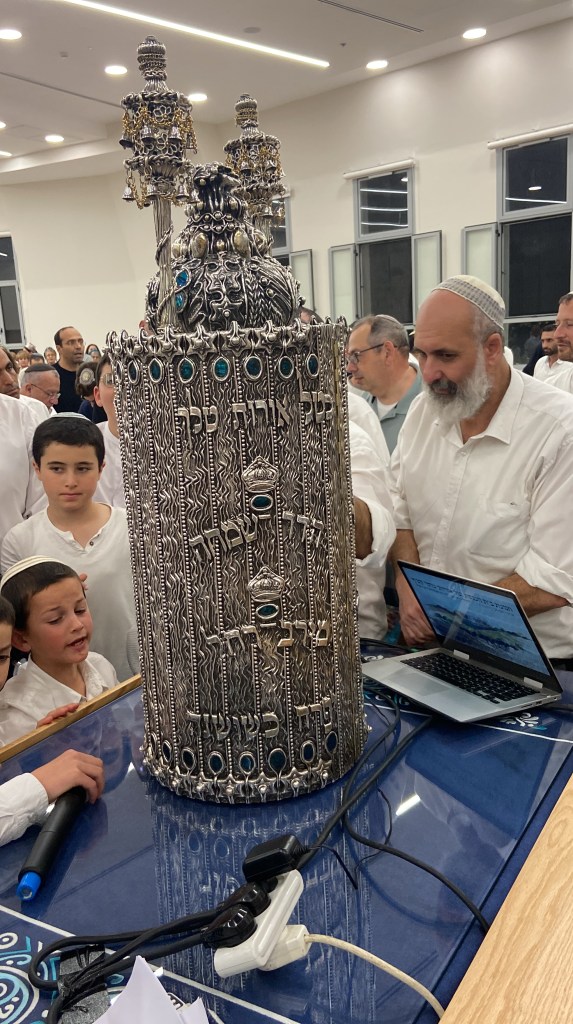
David Hatuel, who lost his entire family in an instance, somehow summoned the courage to move on from this incident. How he did this, I have no idea, and neither do my friends. Yet about a week ago a close friend of mine from the army, Benayah, informed me that the new Yishuv, the new settlement of Karmei Katif where David and his family reside would be holding a special inaugural event where they will be dedicating the new synagogue in Tali and her daughters’ names. In addition they would be dedicating a brand new sefer Torah in their memory. I couldn’t explain why but I felt I simply had to be there. It had been 19 years since the attack and both for the Hatuels, and the community (and for myself) it was time for some kind of closure.
Simcha – The New Synagogue Dedication
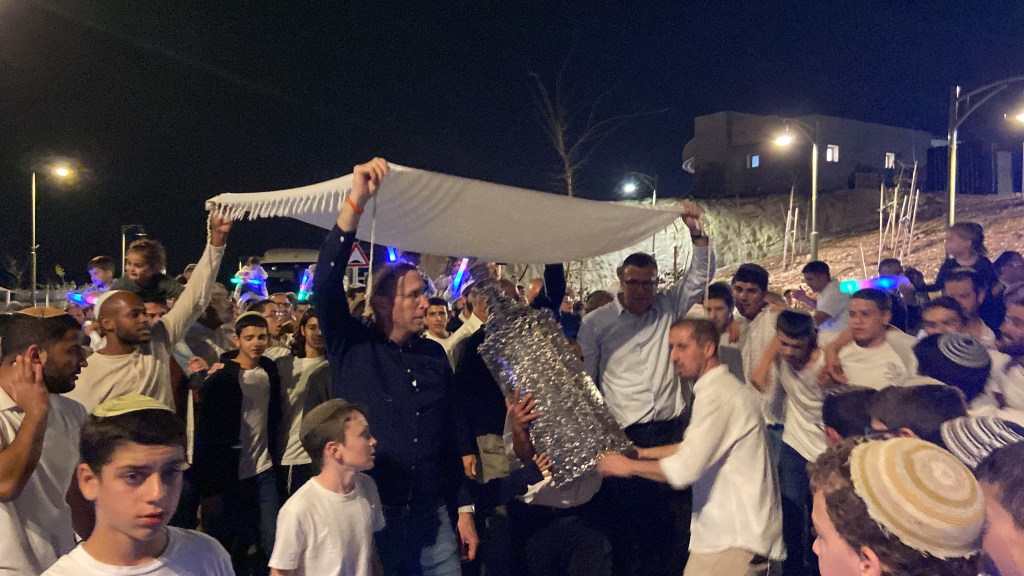
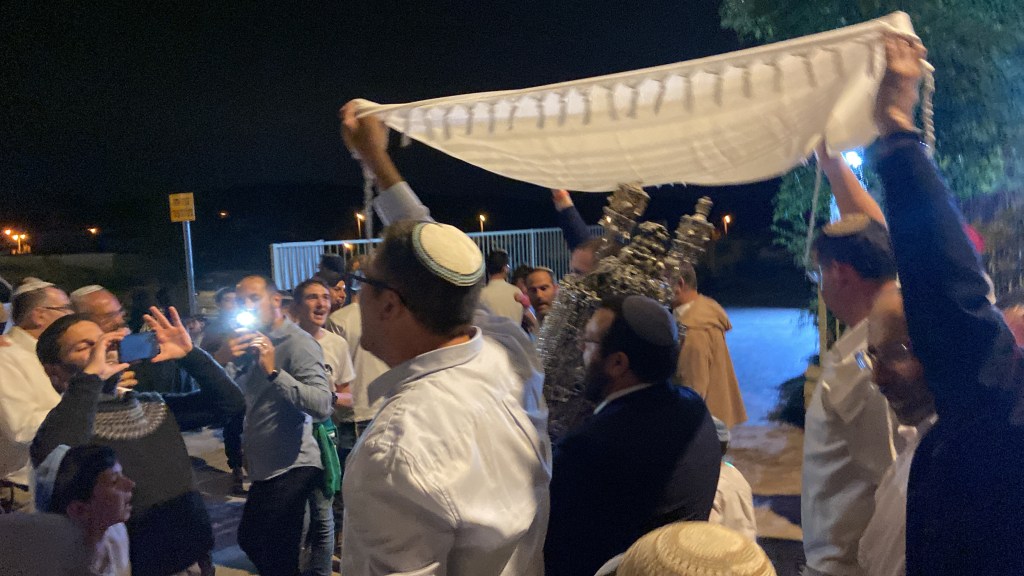
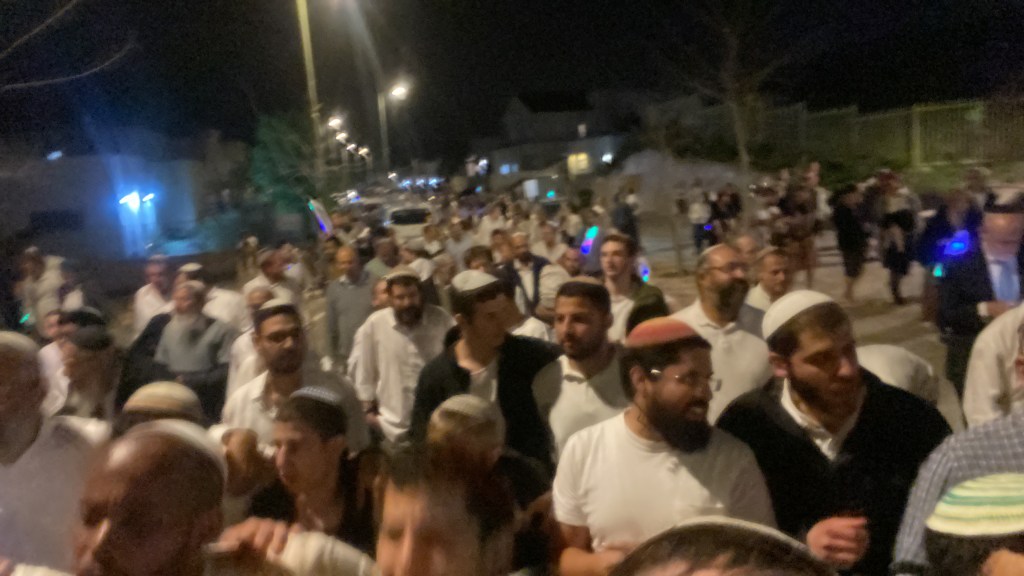
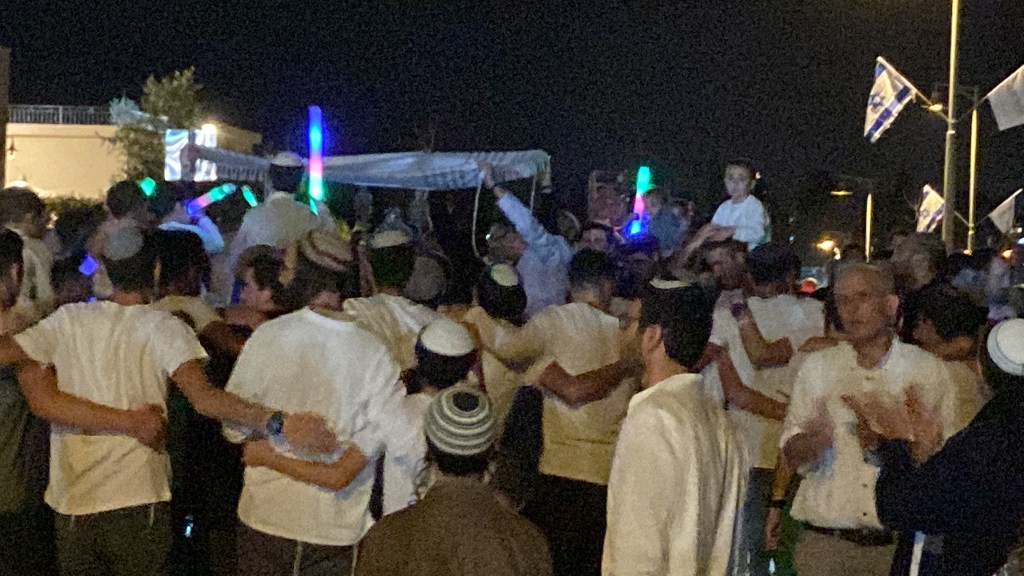
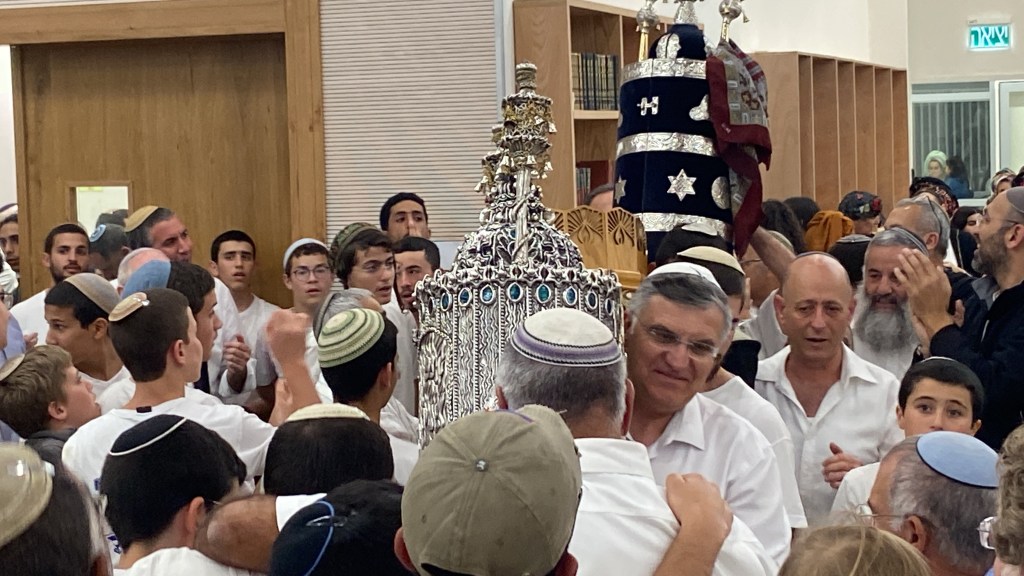
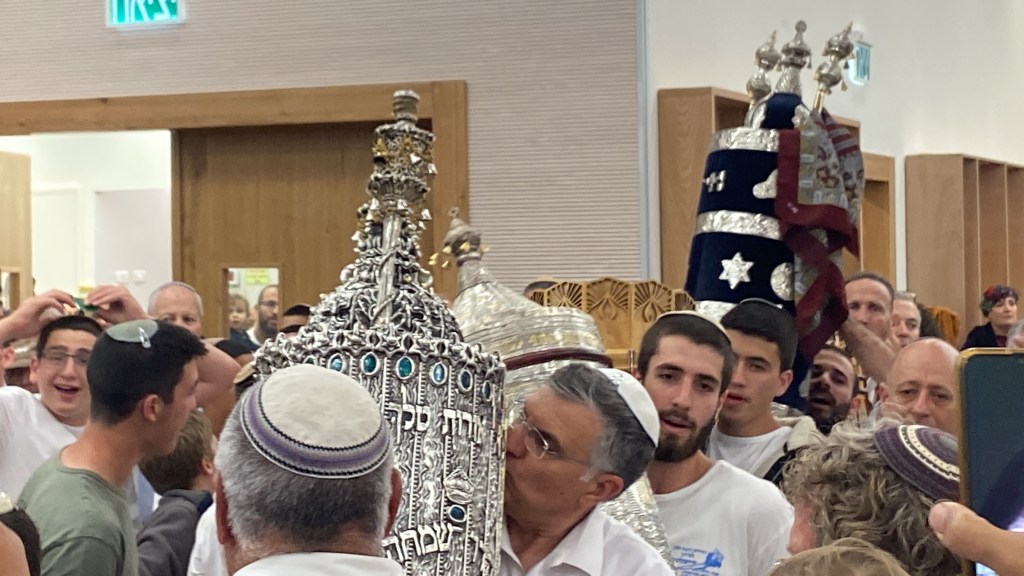
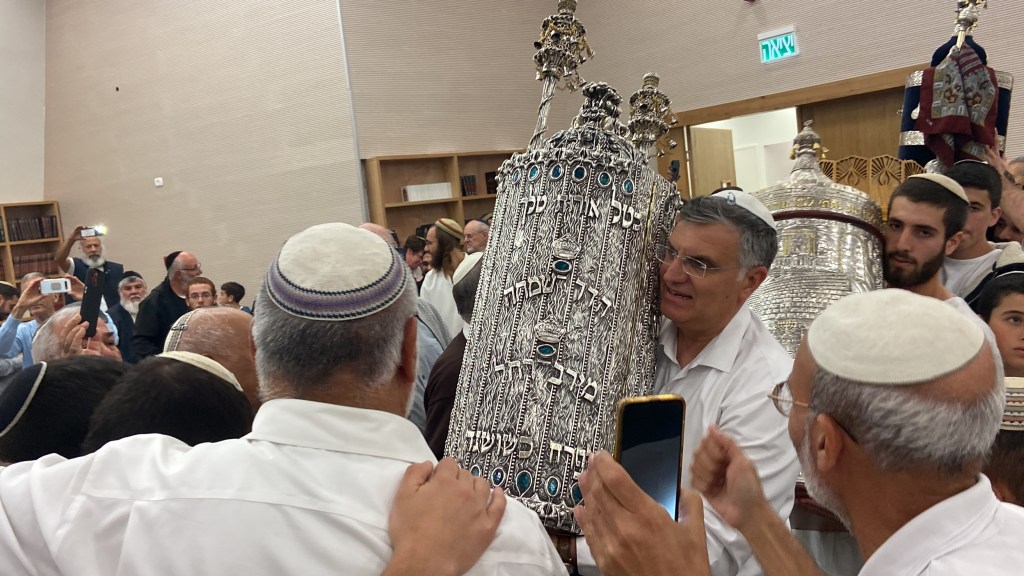
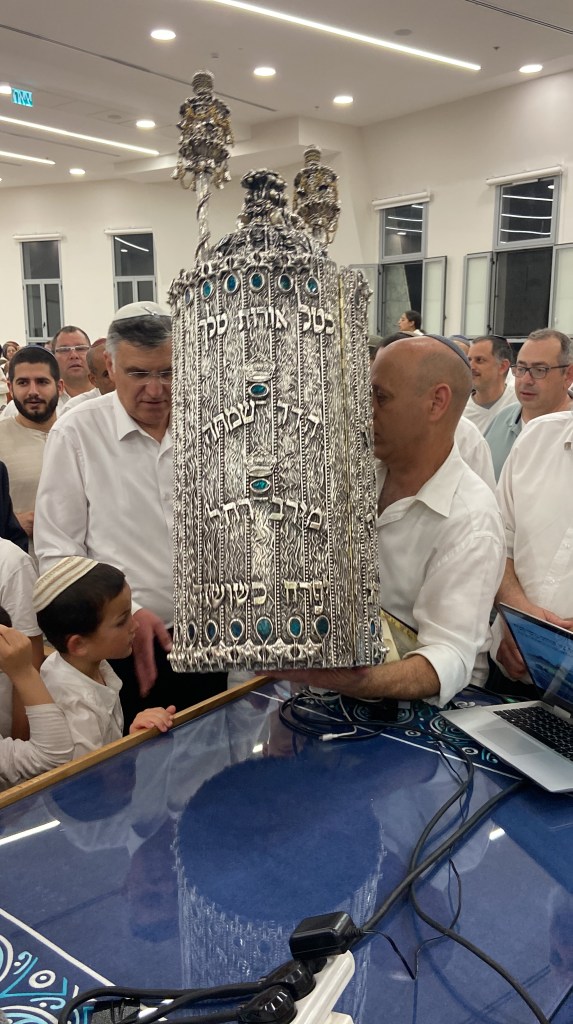
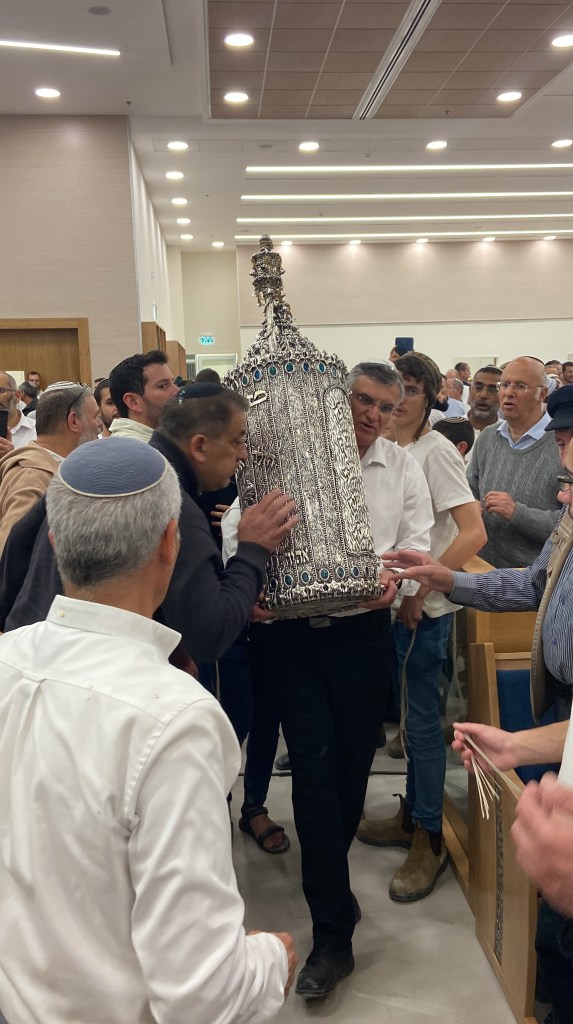
I arrived a little late to the festivities but I quickly joined in as the Torah was marched down the street. David Hatuel who I recognized immediately was holding and dancing with the new Torah, the names of his four daughters adorning the beautiful covering in shimmering silver. As I approached the procession and joined in, dancing with the crowd, coming as close as I dared, I could feel the emotions welling within me. Here I was, 19 years later, and I was celebrating with this man who had lost everything and yet somehow found the strength to continue on. And here we were celebrating life as the community was about to not just dedicate a new synagogue in Tali’s and their childrens’ honor, but also dedicate a new sefer Torah.
I began to cry.
They weren’t just tears of pain, as I relived the horrors of that day. They were tears of joy as life somehow found a way to move forward and carry on. My entire being was begging to be closer to this simcha, and with all my heart I simply wanted to dance with that Torah, to hold it and feel as though that day, in its infamy, could somehow be rebranded to something lasting with joy and life. I moved closer to the procession and found my friend Benaya and embraced him, joining with him as we danced behind the chuppah, the canopy, escorting this new and beautiful Torah to its new home. And there was David Hatuel! Dancing right alongside us. His children dancing alongside him. All of us celebrating this incredible convergence of such profound and sublime significance. Suddenly, as if in slow motion, one of the community rabbis who was overseeing the handling and passing of the Torah, noticed me dancing behind him and turned and asked: “Would you like to hold the Torah?”
He didn’t have to ask twice.
I took the Torah and held it close, my mind racing, unable to find words or meaning or expression. It was 19 years later, and here I was, in a wholly different place, in a wholly different location, in my mind reliving a day of horror in history, yet being present in this moment aware that I was dancing alongside the father of those murdered girls, celebrating with him the profundity and power and strength of Am Yisroel, and the continuation and sacredness of life and Godliness.
I danced and I danced and I danced. I held the Torah and tried to imagine I was holding those young girls, in my mind apologizing for not being able to have done more to save them. Promising and reassuring them that they will never be forgotten. That their memories would forever be etched in the hearts of those around us, and within this sacred scroll that would forever stand as a testament to their being and to the eternality of our People.
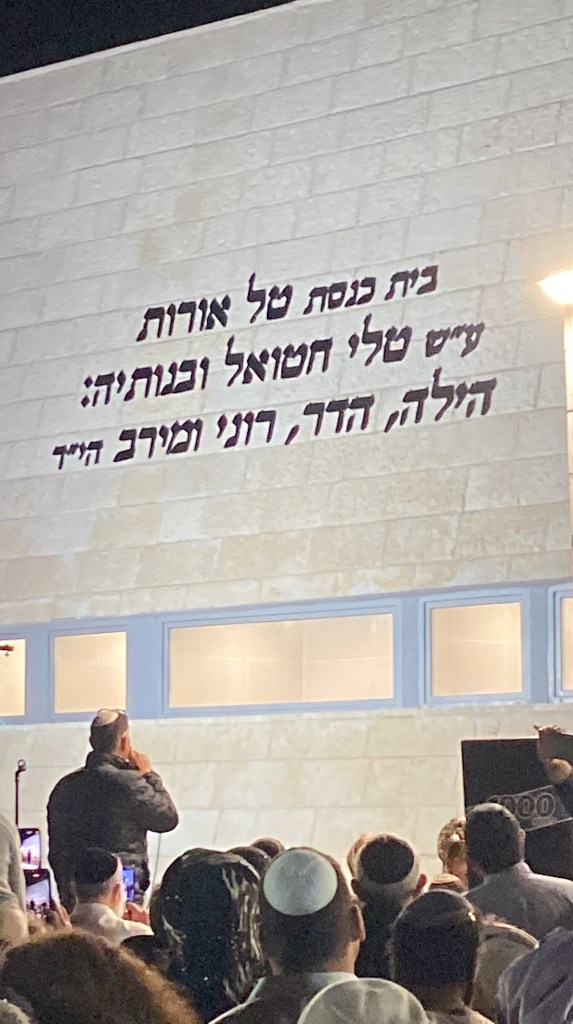
I cannot recall how long I was holding and dancing with the Torah but before I knew it we had arrived at the new synagogue. There was to be an unveiling ceremony and as a speech was made, the curtain was removed from the front facade and the shul’s new name – Tal Orot – appeared. Following the dedication ceremony, new mezuzot were placed upon all the doorframes and we entered into the main sanctuary where there was a public reading from the new Torah. At last, David Hatuel took the Torah and danced with it to the Aron Kodesh as we sang and placed it in its new home.
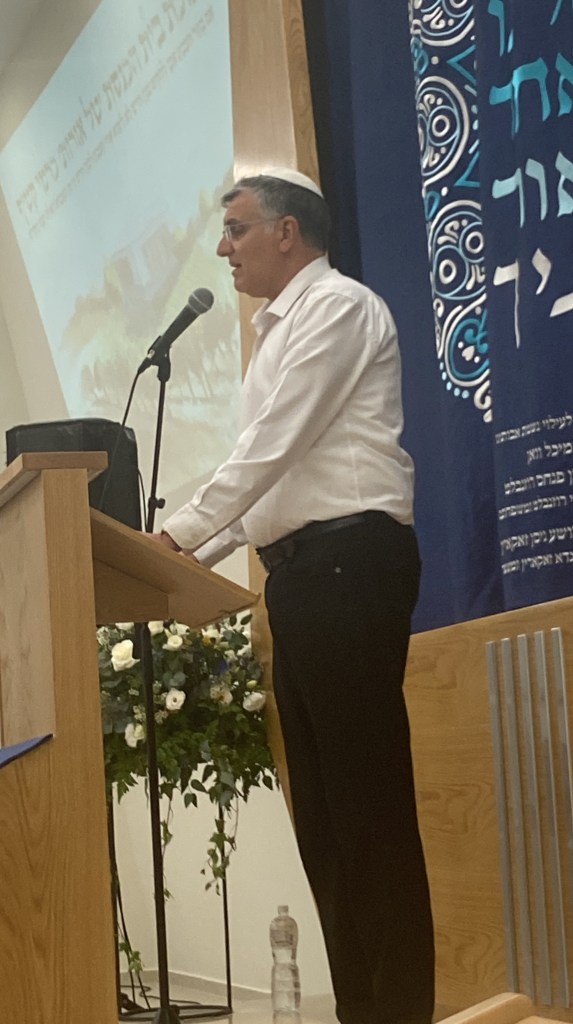
The evening continued with speeches and dedications. Tali Hatuel’s father, Shlomo Malka, spoke. The Chief Rabbi of Ramat Gan, Rav Yakov Ariel spoke. A few other rabbis. And finally, David Hatuel. His remarks were beautiful and he spoke about the horrors of that day 19 years ago, and the long journey and process of moving forward. He praised his community, and then he did something I will never forget. He took the opportunity to address the current political climate in the country concerning the Judicial Reform and stressed that the most important thing that was needed was achdut – unity. And that as their community was one that was evicted from Gaza itself and suffered through the disengagement from Gaza in 2005, one of the most difficult civil upheavals in our young nation’s history, that it was their community that was uniquely placed to help teach this important lesson of achdut to the rest of the nation at this time, and he implored those who were present to do their best to find common ground with those who they disagree with in order to strengthen our connections with each other and not weaken them through division. I could not believe what I was hearing. A man who suffered so much at this personal level encouraging his community to be even more accepting of others was something I had never witnessed. What was even more remarkable was seeing the faces of the people around me smiling and nodding their agreement and assent. I can’t remember being more moved.
When the speeches had concluded and the community finished reciting Maariv, the evening prayer, they went downstairs to the social hall and back patio to begin the seudat mitzvah – the festive meal. It was 10 o’clock, and yet families with their young children stayed, enjoying the meal and each others presence, celebrating the new additions to their community.
All night, my friend Benaya had been imploring me to go say hello to David Hatuel, but something in me just couldn’t bring myself to do it. Whether it was guilt, or fear, I couldn’t tell. Just that every time I tried to approach his table, I found myself hesitating and retreating. At around 10:30pm I said farewell to Benaya and left my table and started making my way to my car. I got about halfway there when something in me just couldn’t rest. I stopped and realized that I couldn’t let this opportunity pass. I turned back, re-entered the dinner, summoned the courage and went over to his table.
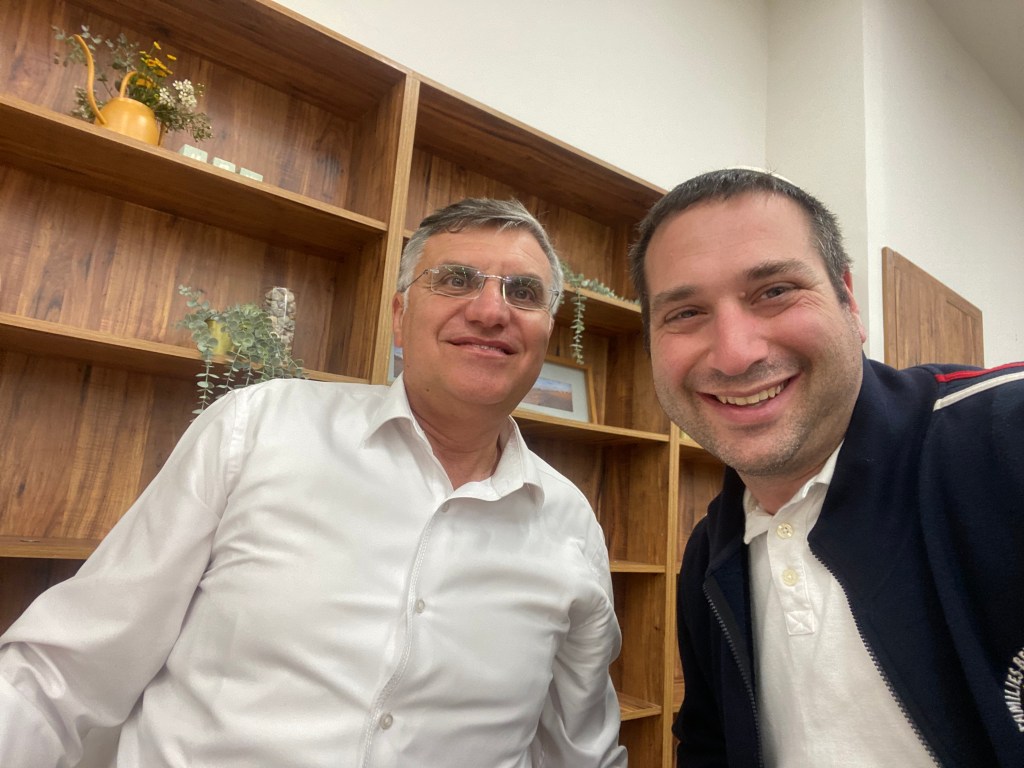
David Hatuel was seated with one of his older sons and with the head rabbis who had made the speeches. Yet when ee saw me approaching, something made him stand up and move to greet me. Though I had imagined this conversation in my mind for years I couldn’t imagine where it would go. I introduced myself and explained that it was my division that was overseeing the security of the road that fateful day 19 years ago and that we truly tried to prevent what happened but alas we had failed terribly. He swatted away my words with his hand and said “Shtuyot” – “Don’t be silly. I have the greatest respect and honor for you and your friends. You have no idea how much we value you and your service and what you did for us while we were living in Gaza.”
I didn’t expect this response and became very emotional. I told him that there are so many of my friends who still live with the events of that day and feel a personal responsibility and blame for what happened. He told me that no one was to blame with the exception of those who carried out the attack. I began to open up. “You know, I’ve wanted to reach out to you for years but never knew how to do it. I’ve felt so guilty.”
“You can always reach out to me,” he responded.
“I never knew what to say.”
He hugged me and said, “Please know that you can always reach out to me. I have the greatest respect for you and would be happy to get to know you better and have you get to know our family.” I smiled and thanked him and then he introduced me to his son. We made chitchat for another minute or two and then I made as if to leave. Before I did though, I turned back to him one last time and said: “You know, I have several friends who it would also probably do them good to speak with you and just get to meet you face to face.”
He smiled even brighter and said, “Please, please tell them, they are welcome anytime. It would be our pleasure to meet with them, even in our home. Please tell them from me, they are always welcome.”
I left the event feeling lighter than I had in years. It’s hard to describe what this event meant to me, and how 19 years after an event it was possible to come full circle and find a way to express both the pain and the sorrow yet the unmatched and profound sense of sublime joy and pride of knowing that Am Yisrael Chai – our nation still lives and is stronger than ever.
We are a nation that values and sanctifies life at every step of our journey. To see how this man was able to summon the strength to not let horror, darkness and sadness destroy his spirit and values was something that moved me to my core. I hope we all can somehow find the means to summon the strength to keep us going during the darkest hours. One thing is for sure, having others there with us to help us through it is without a doubt one of the most important things.
Postscript: Since returning to Israel, I’ve become far more aware of just how many former soldiers suffer from trauma and PTSD. I had no idea it was so rampant here in Israel but the effects and the reality of this condition trail those who suffer with it on an almost constant basis. I myself was suffering with it, not even realizing what the excruciating pains I was feeling were until I figured it out and sought help. There are organizations here and abroad that work with soldiers who have seen combat and traumatic events but here in Israel it is a relatively new field and people in this tough society people are expected to just “toughen up” and “deal with it”. This is easier said than done. While the government has begun to recognize the reality and the broad impact it has on its citizens, unfortunately there is still much more that needs to be done.
If you are interested in helping other soldiers get the help they need, please reach out to me and together perhaps we can get our brothers and sisters the help the so desperately need and deserve.
Standard
I was 11 years old the first time I remember hearing “Eli Tzion” sung on Tisha B’Av.
I was in the Dishner’s Bungalow Colony in South Fallsburg, and somehow, unlike the rest of the kids my age, found myself in shul with the “adults” trying hard to follow the kinnot from those now-collectors edition “Skullcap” kinnot booklets. Suddenly everyone stood up, and began singing the (now) familiar tune “Eli Tzion”. It was easy to follow and figure out how it was sung, the tune not being so difficult to learn. Oddly enough, as the gabbai moved around the shul, I remember feeling incredibly panicked that he would ask me to lead one of the refrains. Lucky for me, despite my height, I (narrowly) escaped his notice and breathed easy on my way back to the bungalow.
Eli Tzion is probably the most well-known kinnah that is recited on Tisha B’av morning. Not only because of its memorable tune that doubles as the tune for Lecha Dodi on Shabbat Chazon, but also because it pretty much marks the end of saying kinnot on Tisha B’Av morning and thus seems to be the much anticipated signal that we can soon leave shul and get ready for chatzot – midday, where we can finally sit on chairs and begin to contemplate how the fast is getting close-to-almost being over.
That’s how it was for me personally, and each year, for the most part, brought the same experience.
As I got a little older, my having attended yeshivot and done some more serious learning helped me begin to appreciate the depth of mourning and connection to Klal Yisroel that one can experience on Tisha B’Av. Naturally, the observance of Tisha B’Av took on new meaning for me, and I could even claim to feel emotion and even genuine sorrow by the time we got around to singing the ol’ Eli Tzion tune. I felt proud that I could connect on a deeper level to the day and its liturgical components. While how well or poorly the fast was going for me certainly played a part in the meaning I felt when concluding kinnot, nevertheless, I thought I had gone about as far as I could go. The tune and kinnah unfortunately was simply an anti-climactic, out of place ending to a long and challenging morning.
That all changed however, the year I visited Chevron Yeshiva in Givaat Mordechai.
My connection with Chevron Yeshiva is one I treasure, and comes through my relationship with one of my rabbeim, Rav Mendel Blachman, who I learned under for more than 7 years and who himself attended that yeshiva and had a deeply personal connection with one of its former Roshei Yeshiva, Rav Simcha Zissel Broide zt”l. It also comes from my relationship with several close friends of mine who attended as talmidim of the yeshiva for several years.
One of those friends, my dear chavrusa from Kerem B’Yavneh, Eliyahu Prero, opted to transfer there after his third year in KBY. And while we were virtually inseparable while we were in yeshiva together for one reason or another, I ended up enlisting and heading off to the IDF while he ended up attending Chevron.
We stayed in close touch he and I, and when I had intermittent moments of leave from the army, he would invite me to come learn b’chavrusa with him at Chevron and we managed to have a very nice weekly, if not monthly, chavrusa together, usually on Erev Shabbos.
When I had the time to change out of my army uniform, I would don the traditional black and white garb of the chareidi yeshivot complete with velvet black yarmulka in order to better blend in. When I didn’t have time, however, I would simply show up in my army fatigues, M-16 in hand, and that would be that. And while occasionally there would be an inquisitive eye or two taking in my presence there, I loved it how virtually no one in the yeshiva paid me any real attention, as if soldiers in madim (uniform) learning b’chavrusa with talmidei chachamim is a completely normal and unexciting occurrence. It didn’t startle anybody, and I really felt right at home.
On Tisha B’Av one year Eliyahu invited me to come and learn with him once again, and we decided that we would learn right after mincha and cover the gemaras in Gittin that speak of the churban, one of the only segments of Torah permissible to learn on that day. I showed up early, and caught the end of kinnot and the Chevron singing of Eli Tzion, and that’s when Tisha B’Av forever changed for me.
I had never heard Eli Tzion sung before in Israel, despite my having lived there for almost six years at that time. Whenever I heard it, it was the typical “American” version I was used to. Being a chazzan, I have always been sensitive to the subtle differences or changes that seem to happen in nusach and musical tunes when they are sung in Israel as opposed to America. Some of the changes are slight: a shortened note here, less “trill” over there. Others are downright hilarious (Shlomo Carlebach would say “Obnoxious”), like how the nusach for the word Romemu in the ending verse of Tehillim 99 from a Carlebach Kabbalat Shabbat in Israel stays flat for some reason, while in America it “correctly” goes up. ;o) Others are just strange, like the beginning of the classic Mishenichnas Adar song for example. (V‘hameivin yavin.)
Eli Tzion in America (and in most places actually) is sung entirely in a major chord. The tune is jumpy, like a march, and there is a strong, consistent rhythm that can even be characterized as fast. I’ve heard many people use its tune to try and describe the kinnah as “positive” or “upbeat”. I have never understood this interpretation since the tune never resonated with me as genuinely representing what was being said. If anything, the tune sounded more like “The Ants Go Marching One-by-One, Hurrah, Hurrah.” (And once you hear it, you can’t unhear it. Sorry!)
I’m well aware of the concept that Klal Yisroel’s mourning pains are ultimately positive, just as a woman’s labor pains are fierce yet lead to a profound outcome (a major theme of the kinnah’s refrain). I’m not talking about that.
I’m talking about how the tune used in the vast majority of kehillot in America (and around the world) for this kinnah just doesn’t seem to reflect or capture the pain, the longing, or the bitter-sweet hope that the author was trying to convey. The familiar tune, in my opinion, never did the kinnah any real justice. In fact, when I was 17 years old and heard one of my Israeli rabbeim comment on how poorly the American version reflected the words, I didn’t quite understand what he was talking about as I didn’t even know of another version.
Until that is, I heard it sung in Chevron.
The version sung in Chevron is patently different. For one thing, it is sung almost entirely in a minor key, which depicts sadness or, more aptly, longing. For another, the rhythm is slow. Very slow. Almost arrhythmic in fact. As if it’s meant to be pondered or cried over as much as sung. When I heard it the first time, it sounded irregular, and very much reminded me of the steps along the Southern Wall of Har HaBayit that were purposely created unevenly so as to force the sojourners to both go slowly so as not to trip, but also to think about their steps and measure them carefully as they ascended to the holiest place on Earth.
In much the same way, the tune for Eli Tzion used in Chevron allows for one to take their time in reciting it, without feeling rushed to have to keep to some external tempo. The words are given time to sink in. The effect is dramatic and extremely soulful.
And hearing 1,000 yeshiva bochrim sing it this way, not only in tune, but in unison, expressing a pain of longing and yearning that is over 2 millenia old, was something so profoundly moving and haunting, there has seldom been an instance I have experienced since that has so perfectly captured such a moment.
When I heard it sung in Chevron, Eli Tzion finally made sense. And it brought me to tears, the likes of which I try very hard each year to return to, as their source is the very wellsprings of our nation’s collective and historical narrative of fall and triumph; of pain, loss and suffering, yet eternal hope for redemption. They are the words that pine to recover what was lost to us so long ago: our walking with God hand in hand to perfect and fill this world in its entirety with His Glory.
And you simply can’t get that with the other version.
In some respects, the quick-tempoed version is very apropos for America, or for the reality so many of us experience nowadays. It’s fast. It doesn’t let you actually think about what you’re saying. You’re so busy responding to what’s going on around you, you don’t actually get to think about what is happening or why or whether it’s important. It marks a welcome ending to a dreary ritual that is experienced by most people as uncomfortable, unrelatable, and almost entirely irrelevant, as opposed to a beginning of something greater that creates connection and meaning. It doesn’t allow one to go any further than surface deep, and by the time you have a moment to possibly ponder what it’s all about, everyone is moving on to the next thing and the moment is lost.
I wonder for how many people this is a pretty good description of what their Yiddishkeit is on a larger level. I can tell you from my decade-long experience working as a Torah educator on college campuses, that for the vast majority of Modern Orthodox youth, this is a pretty apt description indeed.
And no, it doesn’t make the tune or the singing of Eli Tzion any more relatable or relevant to them, unfortunately.
But there is something more out there.
Judaism and Torah is so much deeper and meaningful then we let it be. We’re so bombarded with other things: when is the last time we’ve allowed ourselves a moment to just pause and let ourselves sink in?
My rebbe, the one I mentioned above, once taught me that any time we remove our shoes in Judaism it is a symbolic gesture that means we’re not supposed to go anywhere right now. That right now, for this moment, we’re simply meant to stay put where we are. Shoes are meant for traveling. You put them on when you move locations. There are times when we take our shoes off because we’re simply meant to stay put and not go anywhere. When Kohanim were in the Beis HaMikdash, they didn’t wear shoes because they weren’t going anywhere. On Yom Kippur we remove our leather shoes because we’re just focusing on staying in this moment, on this day, and aren’t concerned about going anywhere else. The same thing is true for mourners and why those who observe shiva remove their shoes: they’re meant to stay in that moment for a while and just be. It’s how we mark moments of importance. Of holiness. It’s why Moshe was commanded to remove his shoes at his first encounter with Hakadosh Baruch Hu at the sneh (burning bush). And why we, too, remove our shoes on Tisha B’Av.
Mourning on Tisha B’Av is hard work. It doesn’t come easily, and it doesn’t come cheap. It takes effort and a lot of focus and concentration. And that’s not at all a simple matter. Especially when you’re fasting in the summertime.
For me I know that I cannot experience Tisha B’Av without hearing the hundreds of voices from Chevron crying out in unison, longing for redemption. I search high and low for others who perhaps recognize the tune, or who at least share a common desire to find a way back to that place… A place with tunes that makes room for self-reflection… That doesn’t march to drumbeats…. That enables and encourages one to find deeper meaning… to connect spiritually and soulfully with one’s past… to ponder one’s life’s meaning… where one wants to go… and to enable one to actually stop and think a moment about what it’s all about…





 Akiva Dovid Weiss